Fire gel, retardant spray or a wildfire sprinkler system?
Which active wildfire defense fits your California home, what it needs, and how sure we are it helps.
It depends on your water and how much warning you get. All three work by keeping embers from catching, and embers can fly a mile ahead of the flames [1].
- Retardant spray is the early start. Sprayed on plants and bare wood in early summer, it keeps working until heavy rain [2].
- Fire gel is for the day a fire comes. It holds a wet coat on walls and wood, but only for a while [3][4].
- A sprinkler system does the most on its own water, set to start without you [5].
Which one fits your home?
Find the row that sounds like your place, then see our pick and why.
| Your home | Our pick | Why |
|---|---|---|
| City or district water | Retardant in early summer. Gel only if you have time before you leave | Sprinklers left on can lower the water pressure firefighters need [6] |
| Well, tank or pool, with backup power | An automated sprinkler system on that water | It can keep running after you leave, for the hours embers fall [1] |
| Wood fence, deck or dry brush near the house | Retardant on the wood and plants | It keeps working after it dries [7] |
| Vents with metal mesh | An ember kit as an extra layer | Kit filters are made to sit behind mesh or code vents [8] |
| One road out, or little warning | Early-summer work only, then leave early | Fire Safe Marin says you must evacuate early [5] |
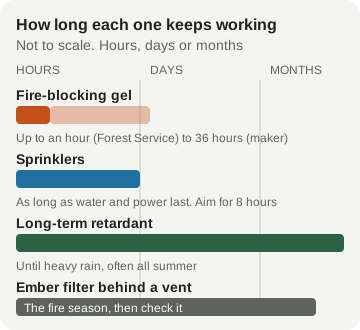
How long each one keeps working once it is on:
How each one works
Each card covers what it does, when it helps most, what it needs, and how sure we are. The tag is our read of the evidence:
- Proven in real fires Careful studies of real wildfires show it works.
- Backed by fire agencies A fire agency tests, uses or recommends it.
- Maker's claim So far, mostly the company's word.
Long-term retardant spray
What it does: leaves fertilizer salts on plants and wood that change how they burn, even after drying [7].
Helps most: on dry grass, brush and bare wood fences, sheds and decks, sprayed at the start of summer [2].
Needs: a garden sprayer [9]. No overhead watering on treated plants, since it washes off. A new coat each summer [2].
How sure: Backed by fire agencies The US Forest Service says these retardants work for days or weeks, until rain or erosion removes them [7]. How well the home version protects houses is the maker's claim.
Example: PHOS-CHEK Wildfire Home Defense, a colorless version of the retardant dropped from planes [9]. It can burn tender leaves and stain bare wood [2]. We could not check a current price.
Fire-blocking gel
What it does: thickens hose water into a wet coat that clings to walls, windows and wood [3].
Helps most: on eaves, windows, doors, decks and wood shake roofs, in the hours before a fire [4].
Needs: at least 30 psi (pounds per square inch) of water pressure, 3 to 5 gallons of concentrate for an average home, and a ladder rather than a walk on a slick roof [4].
How sure: Backed by fire agencies Barricade II is on the US Forest Service's list of gels qualified for fire crews [10]. How well it protects a house is the maker's claim. How long it lasts: 30 minutes to an hour in wildland conditions, says the Forest Service [3]. 6 to 36 hours, says Barricade [4]. Our take: count on the short end.
Example: Barricade Fire Gel Home Kit, four 1 gallon jugs and a hose applicator, $649.95 on Barricade's store [11]. Western buyers are sent to its distributor, Primo Supply [12].
DIY ember kits
What it does: blocks the small openings embers ride in on. SAFE SOSS pairs a filter behind vents with heat-resistant tape and a clear spray from a hose [8].
Helps most: filter in early, tape and spray on when a fire threatens [8].
Needs: mesh or ember-resistant vents already in place, since the filter goes behind them [8].
How sure: Maker's claim Wildland firefighter Nicholai Allen built it as a layer on top of defensible space and hardening [13]. We found no independent test. CAL FIRE does tell evacuees to seal attic and ground vents [6].
Gutter-mount sprinkler kits
What it does: clips sprinklers to gutters or fences, fed by a garden hose [14].
Helps most: on your own well or tank, tried out before fire season [14].
Needs: about 1.5 gallons a minute per head; one hose tap usually runs two. Someone to turn it on, or an irrigation controller [14].
How sure: Maker's claim WASP says over 200 fire departments use its brackets [15]. The real-fire evidence is for bigger, pumped systems (next card). Researchers who studied them advise at least 60 gallons a minute for about an acre [16]. Fire Safe Marin calls ordinary garden sprinklers ineffective [5].
Example: WASP Wildfire Protection Full Kit, $209.95, sold out when we checked [15].
Automated wildfire sprinkler systems
What it does: wets the roof, walls and nearby ground before embers land [1].
Helps most: starting on its own after you leave, with spray that reaches every spot embers collect [5][1].
Needs: water for up to 8 hours [1], a pump with power that survives a shutoff, and a test run each spring [16].
How sure: Backed by fire agencies The North Carolina Forest Service says post-fire assessments show they can help a home survive [1]. In Minnesota's 2007 Ham Lake Fire, 46 of 47 homes and cabins with working sprinklers survived, while 38 of 57 without a working system were lost. That is one fire, and the University of Minnesota researchers call it anecdotal [16]. IBHS, the insurers' research lab, says careful research is limited [17].
Example: Frontline Wildfire Defense, installed by its own crews in California, Colorado and Texas, and Popular Science's 2026 Best Wildfire Defense System [18]. It turns on by itself when a fire is within 7 miles, after a 10 minute countdown on your phone [19]. Systems start around $40,000 for a smaller home, Frontline says [22]. Financing from about $500 a month, reported in 2025. Maker's claim: 59 of 61 homes with it in and around the 2025 Los Angeles fires were saved [20].
We have not tested these products. None of these links earn us money.
Common questions
Don't sprinklers drain the water firefighters need?
On shared water, they can. CAL FIRE says not to leave sprinklers or water running when you evacuate, because it can lower critical water pressure [6]. Our take: a system on its own well, tank or pool, with its own pump and backup power, is a different case. Tell your local fire department it is there, and follow any order to shut it off. Some systems, like Frontline, start on the home's main water [19], so ask how yours is set.
What happens in a power shutoff?
Pumps stop. Utilities turn off power on purpose in very dry, windy weather [6], and the Ham Lake researchers warn that power will likely be off in a wildfire area [16]. Any pump needs backup power that starts without you.
Will any of this lower my insurance?
Probably not on its own. The state's Safer from Wildfires list, which insurance discount rules are built on, covers roofs, vents, the 5 foot zone and defensible space. It does not list sprinklers, gels or sprays [21]. See our insurance checklist.
Should I stay and use them myself?
No. CAL FIRE says to leave right away when officials suggest it, and that leaving before an order is safer [6]. Gel and tape go on only while there is still time to go.
What it means for you
- Harden the house first. Every tool here works better on a home with a clear 5, 30 and 100 feet.
- Pick by your water. Shared water: retardant early, gel if time allows. Your own water with backup power: a system that starts itself.
- Test before fire season. At Ham Lake, some systems failed because pumps did not work, lines were broken or the system was still in winter storage [16].
In Sonoma County? The Sonoma County version lays the same tools out across fire season, with local water and shutoff advice.
Want the whole picture? Take the free wildfire course.
Sources
- North Carolina Forest Service: Exterior Sprinkler Systems, Wildfire Research Fact Sheet (PDF; read November 7, 2026)
- Perimeter Solutions: PHOS-CHEK Wildfire Home Defense FAQs (read November 7, 2026)
- US Forest Service: Water Enhancers Fact Sheet (updated March 2017) (PDF; read November 7, 2026)
- Barricade International: Barricade Fire Gel FAQs (read November 7, 2026)
- Fire Safe Marin: Exterior Sprinkler Systems (read November 7, 2026)
- CAL FIRE, Ready for Wildfire: Go! Evacuation Guide (read November 7, 2026)
- US Forest Service, Wildland Fire Chemical Systems: What are wildland fire chemicals? (read November 7, 2026)
- SAFE SOSS: Supplemental Wildfire Safety Products (read November 7, 2026)
- Perimeter Solutions: Launch of PHOS-CHEK Wildfire Home Defense (July 17, 2019) (read November 7, 2026)
- US Forest Service: Water Enhancers for Wildland Fire Management, Qualified Products List (December 5, 2024) (PDF; read November 7, 2026)
- Barricade International: Barricade Fire Gel Home Kit (price checked November 7, 2026)
- Barricade International: Barricade Fire Gel home page (read November 7, 2026)
- Lowe's: What a wildfire firefighter wants homeowners to know before the next fire (October 1, 2026) (read November 7, 2026)
- WASP Wildfire: FAQs (read November 7, 2026)
- WASP Wildfire: Wildfire Protection Full Kit (with hoses) (price checked November 7, 2026)
- Johnson, Downing and Nelson, University of Minnesota Department of Forest Resources: External Sprinkler Systems and Defensible Space, Lessons Learned from the Ham Lake Fire and the Gunflint Trail (April 15, 2008), for the Minnesota DNR Firewise Program (PDF, copy posted by a sprinkler maker; read November 7, 2026)
- IBHS: External Sprinklers for Wildfire Defense (October 3, 2024) (read November 7, 2026)
- Popular Science: 2026 Home of the Future awards (July 23, 2026) (read November 7, 2026)
- Frontline Wildfire Defense: Wildfire Sprinkler System (read November 7, 2026)
- KTVU FOX 2: High-tech exterior sprinklers can save homes from wildfires (April 21, 2025) (company figures, financing; read November 7, 2026)
- United Policyholders: California's Safer from Wildfires shows how to protect homes, get insurance discounts (2022) (the list of actions; read November 7, 2026)
- Frontline Wildfire Defense: Get started form (pricing note) (read November 7, 2026)
Products and prices change. Sources last checked November 7, 2026. General information, not engineering advice. Follow the maker's instructions and your local fire officials.